An embryo produced by ICSI gives, in the vast majority of cases, a single foal. It can nevertheless divide after transfer and give monozygotic twins, that is, twins derived from a single embryo and genetically identical. This is rare, but more frequent than with an embryo recovered by uterine flushing, and these twins escape the usual day-14 check.
What we call an “embryo”
The same word refers to several very different stages.
The embryo transferred at around seven or eight days is a blastocyst. It is a small sphere whose wall carries a denser cluster of cells, the inner cell mass. The foal will develop from this cluster alone; the rest of the sphere will form its membranes.
After transfer, the sphere grows in the uterus. On ultrasound it appears as a round, black vesicle, but with nothing inside during the first two weeks. The embryo proper, derived from the inner cell mass, only appears on ultrasound at around day 21, at the bottom of the vesicle. Its heart beats from about day 25.
Where these twins come from
In the mare, most monozygotic twins described arise from an inner cell mass that has split within a single blastocyst. They then share one vesicle and one chorion, but each develops in its own amnion. More rarely, the embryo separates earlier, before the blastocyst stage, and gives two distinct vesicles.
The mechanism that favours this split in in vitro production is not established. In the main published series, it occurred in 1.6% of pregnancies obtained with in vitro produced embryos (4 of 254), compared with none with in vivo embryos (0 of 413).
Why they are not seen at the first check
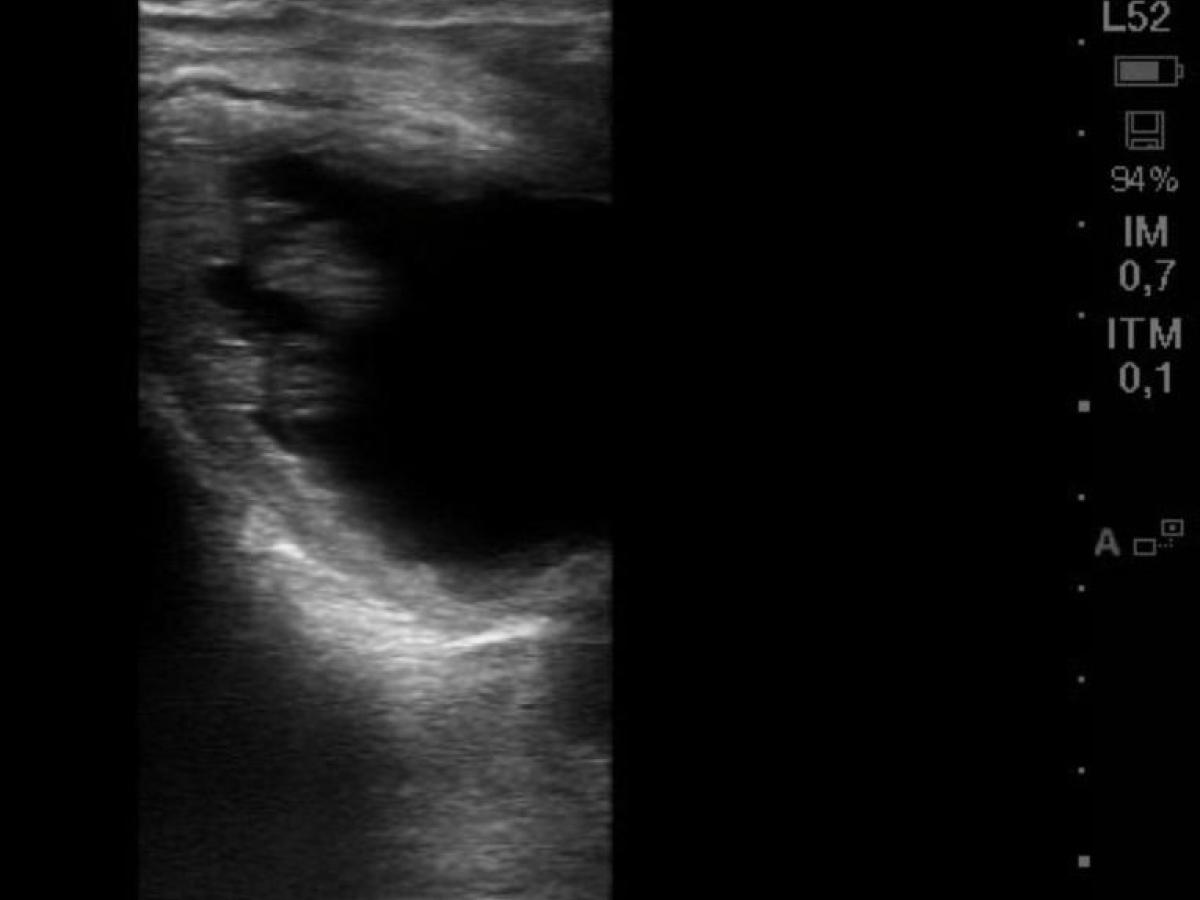
Ordinary twins, from two ovulations, are detected between days 14 and 16: two vesicles are seen, and one can be reduced before they become fixed. Monozygotic twins form a single vesicle. At the first check, nothing distinguishes them from a single pregnancy. They can only be recognised once the embryos are visible, at around day 21, and their two hearts at around day 25.
This is why we ask for the recipient of an ICSI embryo to be presented to us at around day 25.
What to do if they are present
Because they share the same chorion, monozygotic twins respond poorly to the reduction techniques used for ordinary twins. Only two successful reductions have been published, one at 65 days and the other at 128 days of gestation. In most cases described, both fetuses were lost after the attempt, and a twin pregnancy left to itself usually ends in late abortion.
The Ghent University team, which published the largest case series, currently considers terminating the pregnancy before 35 days, with a single injection, to be the most appropriate solution. At that stage, the recipient returns to oestrus within a few days and can receive another embryo. If your mare has other frozen embryos, the season is therefore not lost.
We discuss it with you before any decision.
References
- Dijkstra A., Cuervo-Arango J., Stout T.A.E., Claes A. Monozygotic multiple pregnancies after transfer of single in vitro produced equine embryos. Equine Veterinary Journal, 2020, 52, 258-261.
- Peere S., Papas M., Gerits I., Van den Branden E., Smits K., Govaere J. Management of monozygotic twins in the mare. Journal of Equine Veterinary Science, 2022, 113, 103988.
- Peere S., Van den Branden E., Papas M., Gerits I., Smits K., Govaere J. Twin management in the mare: a review. Equine Veterinary Journal, 2024, 56, 650-659.
- Roberts M.A., London K., Campos-Chillón L.F., Altermatt J.L. Presumed monozygotic twins develop following transfer of an in vitro-produced equine embryo. Journal of Equine Science, 2015, 26, 89-94.