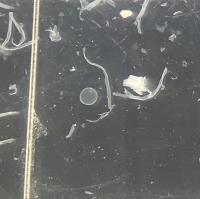
Multiplying Excellence... Embryo transfer is a reproductive biotechnology technique that allows for obtaining one or more foals from an elite mare during a single season, while allowing her to continue her sporting career or preserve her health.
Why Choose Embryo Transfer?
- Maintaining Sporting Career: Your mare remains in competition while her "recipient" carries the foal.
- Intensified Production: Obtain several offspring per year from the same exceptional lineage.
- At-Risk Mares: Provide offspring for mares with physiological difficulties in carrying a pregnancy to term.
- Young Mares: Test the production quality of a 3 or 4-year-old without interrupting her growth.
Recipient Management
The success of a transfer relies on precise synchronization (within plus or minus 24 hours) between the ovulation of the donor mare and that of the recipient mare.
- Our Internal Herd: We have a group of recipient mares selected for their maternal abilities. If a recipient from our herd shows ideal synchronization, the transfer is performed immediately on-site.
- Maximizing Chances: If none of our mares offer a perfect synchronization window at the time of collection, we take no risks. The embryo is then conditioned and sent urgently to a partner implantation center with a wide choice of recipients, to guarantee the best possible success rate.
- Working with Your Own Mares: We can also attempt the transfer on a recipient mare provided by the breeder. However, it is important to note that if synchronization is not optimal (asynchrony), the success rate decreases. In this case, we often advise prioritizing an external transfer to avoid losing the collected embryo.
Pregnancy Monitoring
The security of your investment is our priority.
- Rigorous Checks: From the 14th day (D14), the recipient mare undergoes regular ultrasound monitoring. Several checks are performed during the first weeks to ensure embryonic viability.
- Leaving the Center: The recipient mare only leaves our facility after the critical 45-day pregnancy mark, once stabilization is confirmed.
- Insurance: For greater peace of mind, there are possibilities to insure pregnancies. We can refer you to our partner insurers or provide the necessary documents for your own insurance.
Optimization and Success of the "Flush"
The collection of the embryo (the flush) depends on many biological factors.
In case of a negative flush: If no embryo is collected, the procedure can be repeated during the next cycle.
Consulting Expertise: To optimize chances, we analyze each situation: mare fertility and semen quality are paramount. We assist you in finding the best balance between your genetic choices and technical success probabilities.
Conventional Embryos vs. ICSI
It is essential to distinguish between the two techniques:
- Conventional Embryo (In Vivo): Obtained by classic insemination. Its structure makes it very fragile for freezing, which is why we systematically prioritize fresh embryo transfer.
- ICSI Embryo (In Vitro): Derived from ovum pick-up; this technique follows a specific protocol. The ICSI embryo handles cryopreservation very well. To learn more about this technique, visit our page dedicated to ICSI and OPU.
Embryo Collapsing and Biopsy
The field of equine reproduction is evolving rapidly. Techniques such as embryo collapsing (reducing fluid volume to secure transport or freezing) or embryo biopsy (for sexing or genetic diagnosis) are being developed. Although these procedures are not yet routine, we work in collaboration with specialized laboratories to offer you these options. We are at your disposal to advise you and coordinate these cutting-edge interventions.
Find details of our rates (collection, transfer, rental fees) on our Rates page.